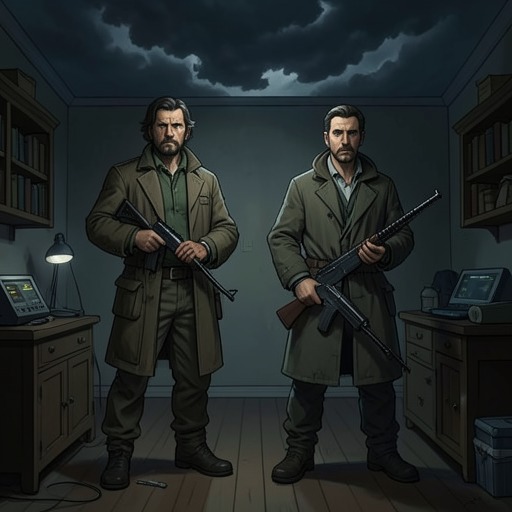
Coldiron USA headquarters
The PeripheralColdiron USA headquarters occupies a former mini-paintball shop in a Clanton strip mall. Burton Fisher acquires it as a shared base for work and equipment, with the move helping keep danger away from his mother’s home; as Coldiron’s local operations expand and threats intensify, the modest storefront becomes both a corporate outpost and a makeshift fort. Its transformation gives the building a double meaning: a practical center for a new enterprise, and a measure of how thoroughly business, family life, and armed conflict have become entangled.
Setting and Acquisition
The headquarters stands at the town end of a strip mall, opposite Sushi Barn, with three empty stores between them. The former mini-paintball shop had been one of the mall’s few businesses to thrive when its small paintball robots were popular. The neighboring units had housed a nail-and-hair-extension business or remained vacant; by the time Burton brings Flynne Fisher to the property, the shop’s windows are covered inside with sticky gray plastic that is peeling at the corners.
Burton pulls a rental car into the lot and points out the storefront as theirs. The papers are still going through, but his declaration makes a vacant commercial unit the basis for a new local operation. For Flynne, the purchase is difficult to imagine both because of the money it implies and because the empty-looking shop seems an unlikely object of ambition. The contrast between its shabby exterior and Burton’s confidence sets the tone for the headquarters: its importance comes less from its appearance than from the work and pressure it will have to contain.
Work and Local Operations
Burton explains the practical reasons for centralizing. Macon needs space for his printers, and the group needs a place to work; Shaylene’s back room is no longer adequate, and running operations from a trailer by the creek is not viable. Moving into the strip mall also shifts the group’s activity away from Burton’s mother, Ella, reducing the exposure of the family home as their needs grow.
The move is connected to a wider change in the local business landscape. Shaylene has sold her business to Coldiron after meeting Flynne and seeing what Macon can fabricate. The new headquarters therefore sits within an expanding commercial network rather than serving only as a private workshop. When Macon opens its blank gray glass door to welcome the others, he presents it as the North American flagship and headquarters. His buttoned blue business shirt and mostly black striped tie are paired with old, holey jeans, a small visual mismatch that captures the gap between the company’s formal ambitions and its improvised beginnings.
From Storefront to Stronghold
The building’s function changes as the danger around the operation increases. When Flynne later returns, the outside of the windows and door has been washed, but the interior has been extensively reinforced. Bags of roofing shingles form thick barricade walls, roughly three feet thick and seven feet high, around the inside of the shop. Madison has sprayed a layer of Hefty polymer on the windows to keep shattered glass from flying, while the front entrance is covered with layered material from Carlos’s protective vest, designed to stiffen momentarily when struck by a bullet.
Tarps hang from the rafters, fastened with the same bland blue Homes zip ties Flynne remembers from being bound to a table at Pickett’s. The security work makes the store’s earlier blankness deceptive: behind the washed windows is an improvised defensive perimeter built from construction supplies and repurposed protective materials. The building has not become invulnerable—Flynne understands that the polymer will not stop a bullet, and the vest material can transmit enough force to break an arm—but the layers are meant to reduce the harm of an attack and limit flying glass.
A later route to Sushi Barn makes the headquarters’ defensive architecture even more visible. Madison has built two seven-foot walls of shingle bags through the vacant shops, linking a hole in the back of Coldiron to Hong’s kitchen. The passage resembles a giant hamster run more than a conventional corridor: protection has extended beyond the headquarters itself, turning the empty units in the mall into part of a guarded path between work sites.
People and Significance
Burton, Macon, Shaylene, and Madison shape different aspects of the site’s development. Burton arranges the purchase and frames it as a necessary base; Macon needs room for his printers and presents the finished storefront as a corporate headquarters; Shaylene’s move into Coldiron’s orbit accompanies the expansion; and Madison’s shingle-bag walls and window protections adapt the building to the threat of gunfire. Conner Penske is also present at the headquarters: Burton lifts him as he would a child who cannot walk, and Conner, who has one arm, puts that arm around Burton’s neck, a familiar gesture that places their personal bond inside the same vulnerable working environment.
The fortification acquires a larger political context when the scale of Coldiron’s growth is voiced directly. Asked why there is a fort made of building supplies next door, Flynne is told that Coldiron’s global valuation is now in the billions. The makeshift defenses and the company’s enormous valuation occupy the same landscape: one reveals the reach of corporate capital, the other the local violence that accompanies its arrival. Coldiron USA headquarters is thus neither simply an office nor merely a bunker. Its changing use—from empty shop to fabrication base, flagship, and protected passage—shows a fragile local enterprise trying to establish itself while the surrounding contest over money and power turns ordinary commercial space into contested ground.